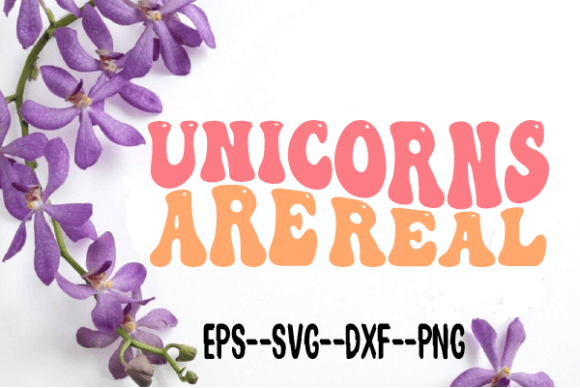
Unicorns Are Real Unicorn Retro Wavy SVG
A Designer’s First Look: Playful, Nostalgic, and Built for Charm
When Unicorns Are Real Unicorn Retro Wavy SVG landed in my inbox, I paused—not because it’s flashy, but because it *feels* intentional. The wavy silhouette, the soft retro curves, the subtle asymmetry in the horn and mane—it doesn’t scream “trend-chaser.” It whispers “handmade with care.” As someone who’s stitched hundreds of unicorn motifs for baby onesies, boutique aprons, and Etsy gift sets, I immediately pictured this on a linen tea towel or a cotton tote bag—something tactile, warm, and quietly joyful. It’s not hyper-detailed or overly ornate, which is a relief. That simplicity translates well to embroidery: fewer tiny corners to snag, less risk of thread piling up in tight spots.
How It Holds Up on Real Embroidery Projects
I tested Unicorns Are Real Unicorn Retro Wavy SVG as a machine embroidery design on three very different substrates: a medium-weight cotton sweatshirt (for a small shop holiday collection), a lightweight organic cotton baby blanket, and a structured canvas tote bag. On the sweatshirt, the flowy outline translated beautifully into satin stitch—clean edges, no puckering when paired with medium tear-away stabilizer. The curve of the unicorn’s back became a natural guide for stitch direction, giving subtle dimension without needing complex underlay.
On the baby blanket? A gentle reminder: this design shines best at 3.5–4.5 inches wide. Smaller than that, the wavy mane loses definition; larger, it stays balanced and friendly—not cartoonish, not too precious. For personalized gifts like nursery decor or first-birthday pillows, it lands just right: recognizable, sweet, and ageless enough to hang in a teen’s room or a grandmother’s guest bedroom.
As a tote bag design, it performed exceptionally well. The open negative space inside the unicorn’s outline left room for breathable fill stitch—or even a light applique layer if you wanted texture contrast. No dense fill areas meant minimal stabilizer show-through on the reverse side, a big win for handmade product presentation.
Where to Use It Thoughtfully
- Small hoop sizes: Avoid stitching it smaller than 3 inches—fine details like the tip of the horn or the inner wave curve may not resolve cleanly.
- Textured or stretchy fabric: Works on stable knits with proper cut-away stabilizer, but skip it for slinky jersey or heavily brushed fleece unless you test first. The wavy lines rely on clean tension.
- Dark fabric: Absolutely viable—but choose thread colors with enough contrast. A soft lavender unicorn on charcoal gray reads beautifully; pale yellow on navy fades visually.
- Curved surfaces (caps, hats): Not ideal out-of-the-box. The continuous wavy line doesn’t adapt easily to dome-shaped hoops. Better suited for flat or gently contoured items like pillow covers or aprons.
- Frequent-wash items: Because it avoids ultra-fine linework or micro-satins, Unicorns Are Real Unicorn Retro Wavy SVG holds up well on kitchen towels and kids’ clothing—just confirm your stitch density isn’t over-compressed.
What It Adds to Your Craft Business—and What It Doesn’t Promise
This isn’t a “plug-and-stitch” logo replacement. It’s a mood-setter. As an Etsy seller, I’ve used Unicorns Are Real Unicorn Retro Wavy SVG in listings for embroidered tea towels and matching pillow covers—pairing it with handwritten-style “Magic Happens Here” text. Customers consistently comment on how “whimsical but not childish” it feels. That nuance builds trust: it signals thoughtfulness, not just decoration.
For small shop product branding, it works best as a secondary motif—not your primary logo, but the charming accent on packaging tags, thank-you cards, or the inside seam of a handmade apron. Its retro wavy rhythm gives cohesion across product types without locking you into one aesthetic.
It won’t carry heavy typography or intricate gradients—this is a Graphics file, not a photorealistic embroidery file. Don’t expect built-in shadow layers or multi-color satin blends. What you get is clean, scalable vector art: one DXF, one EPS, one SVG. That means flexibility—you decide how to interpret it: as a single-outline running stitch, a bold satin border, or a layered applique design with fabric accents.
Practical Notes Every Embroidery Designer Should Check
- Test the design on scrap fabric *first*, especially if using textured or dark materials.
- Review stitch density in your embroidery software—adjust if needed for lightweight fabrics or high-contrast thread combos.
- Confirm hoop size compatibility before digitizing; the natural width fits standard 4x4 and 5x7 hoops comfortably.
- Inspect small details at 200% zoom: ensure the horn tip and inner wave breaks remain distinct after conversion to embroidery format.
- Try black-and-white mockups to assess silhouette strength—this design relies on shape, not shading.
- Compare performance on light vs. dark backgrounds; thread color choice changes its personality dramatically.
- Use appropriate stabilizer—medium tear-away for cottons, cut-away for knits, and avoid heat-sensitive synthetics unless tested.
- Verify licensing terms before selling finished products or digital embroidery files—this listing mentions sublimation and printable use, but commercial embroidery rights should be confirmed directly with the seller.
Final Thought: A Design That Serves the Maker
Unicorns Are Real Unicorn Retro Wavy SVG doesn’t try to do everything. It does one thing very well: offer a lighthearted, cohesive, and stitch-friendly motif for craft business owners who value clarity, charm, and real-world usability. Whether you’re prepping a custom embroidered patch for a local festival, designing a batch of holiday sweatshirts, or building a cohesive Etsy collection around “whimsy with warmth,” this design earns its place—not as background noise, but as a quiet signature. It’s the kind of embroidery file that makes customers smile *before* they even touch the fabric. And in the world of handmade product, that’s worth more than perfect pixels.